1. "Taxes are at an all-time high!"
It's a classic refrain in conservative circles: "Taxes are the highest they've ever been, and they're getting higher. The feds are squeezing us dry!" So taxes must be pretty darn high, right? Well...
Rating: Completely Wrong
Taxes are actually at historic lows. In fact, the average federal tax rates are actually at the lowest they've been for 60+ years, according to the federal reserve. Of course, taxes aren't one homogeneous thing, so I'll break it down into separate categories.
a. They're taxing the rich more than ever!"
Rating: Completely Wrong
Thanks to the Bush administration and congressional Republicans, taxes on the rich are at an all-time low, continuing the pattern that was set by Reagan. The top marginal tax rate was slashed by the Bush Tax cuts, helping the nation's top richest 1% hold on to more of their money. But the real winners here are the top .01%. Bush repealed the estate tax and slashed capital gains taxes, both of which benefited the ultra-rich immensely. Take a look at the following graph:

As you can see, taxes on the ultra-rich are at the lowest they've been in sixty years. Now this graph is a little misleading, since it only goes back to 1945. So let's take a look all the way back to 1913.
The following graphs, taken from qz.com, shows the effective income tax rates of people who make $10,000,000 a year:

So in 2012, they paid an effective income rate of 34.8%, which is significantly lower than they've paid for most of the last century. But their real tax rate is much lower than that. The highest income bracket gets more than half their income from capital gains, which is taxed at far lower rates than income tax. That means that the ultra-rich, on top of being able to generate massive income purely by investing money, also get to pay very low tax rates.
Now, you might be thinking, "but don't ultra-low capital gains taxes help boost the economy?" I'll look at the issue of capital gains more in-depth in a later post. The short answer, though, is that while extremely high capital gains taxes would almost certainly hurt the economy, raising them a bit would almost certainly have no real impact.
Of course, not every one makes $10,000,000 a year. What about those poor souls who only make $1,000,000? Well, as it turns out, things look pretty similar:

Since 1945, the tax rate follows a pattern that's pretty similar to their ultra-rich brethren, albeit slightly lower. Admittedly, taxes on $10,000,000-ionares aren't quite as low as they were in the late eighties, and are a good deal higher than they were before 1926 or after 1925-1931. Still, taxes on the rich are far lower than they have been for most of the century, and the lowest they have been in twenty years.

b. They're taxing the middle class more than ever!
Rating: Wrong
I'll keep this one short, but look at this graph and try to tell me that middle-class taxes are at an all-time high. Just try me.
Let's look how much a married couple with a shared income of $50,000 is taxed:

A mere 13.3%. Tax rates on the middle-class have been slowly, gradually dropping for 50+ years. But what about families who are a bit more wealthy? Say, a shared income of $100,000? Surely they're struggling mightily under their burden. Let's see:

Nope. While they pay a somewhat higher tax rate, at 17.1%, their income has been dropping slowly since they WWII. They're even lower than they were during the Reagon era. I guess those Obama tax increases must be hiding?
Of course, middle class tax rates aren't actually that low; payroll taxes, state income taxes and others take their toll. Still, it's pretty clear: income taxes are relatively low, and are dropping, not increasing.
Complained no Republican ever. I'm being a bit facetious, but that's how it seems sometimes. That's right, for some reason the "taxation is theft" crowd is often a bit mum when it comes to poor people. So I'm going to look at the flip side:
c. "The working poor don't even pay taxes!"
Rating: Mostly False
Those freeloading working poor. Slacking off at their back-breaking jobs, bringing home tens of tens of dollars with each paycheck. Spending their money on self-indulgent frivolities like food and clothing... And getting a tax break all the while. So lets see how those hard-working leeches are doing. This is how much a family of two and an income of $10,000 gets taxed:

10.0%. Their income taxes have been dropping steadily for the last 50+ years. They're at their lowest during the Reagan administration, but otherwise follow a steady decline. Doesn't sound too shabby, until you remember they're only making $10,000 a year. But still, 10% isn't that bad, is it?
Except for one thing: they're often hit harder by payroll taxes than income taxes. And unlike income tax, payroll taxes have been rising steadily for the last sixty years, before stagnating over the past decade. Check out this graph, from the WonkBlog:

It's getting higher and higher! Those filthy, money-grubbing Democrats! Oh, wait. That's right, it's not the democrats who want to raise payroll taxes. Payroll taxes, which disproportionately affect the working poor, seems to be the one kind of tax increase that Republicans don't mind. But surely Grover Norquist, with his famous Taxpayer Protection Pledge, must be against raising the payroll tax? Well, even Mr. no-new-taxes gets a bit wishy-washy when it comes to payroll tax increases. If by wishy-washy, you mean actively called for the payroll tax to be increased. In violation of a pledge that he not only signed, but created.
That's right, kids: taxing millionaires is theft. But the working poor? Hell, they're all freeloaders anyway. Just tax the hell out of them. They're lucky they even have jobs, seeing as...
d. "Businesses are failing because corporate taxes are at an all-time high!"
Rating: Completely Wrong
At 35%, The U.S.'s federal nominal corporate tax rate is the highest of any developed country. So obviously we have high corporate taxes, right? Wrong. Here's why:
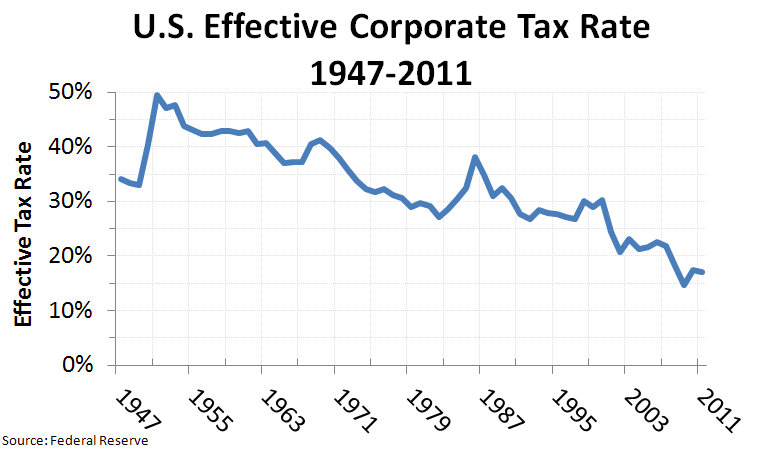
As a result, corporate income tax makes up a shrinking part of the GDP, as you can see below:

And if the corporations are hurting, they sure aren't showing it. On top of CEO to employee wage rations being at record highs, corporate profits are at an all-time high:

You could reasonably use all of this data to make a case that low tax rates have helped corporations flourish. What you couldn't reasonably do, at least without inventing your own facts, is argue that corporate tax rates are at an all-time high. They aren't.
